
Crude's Anomaly: WTI Slides Below $70 Despite Iran Tensions
WTI crude shrugs off Iranian attack on cargo ship, falling below $70 as traders bet that Strait of Hormuz supply risks are fading. What's really moving CLUSD?
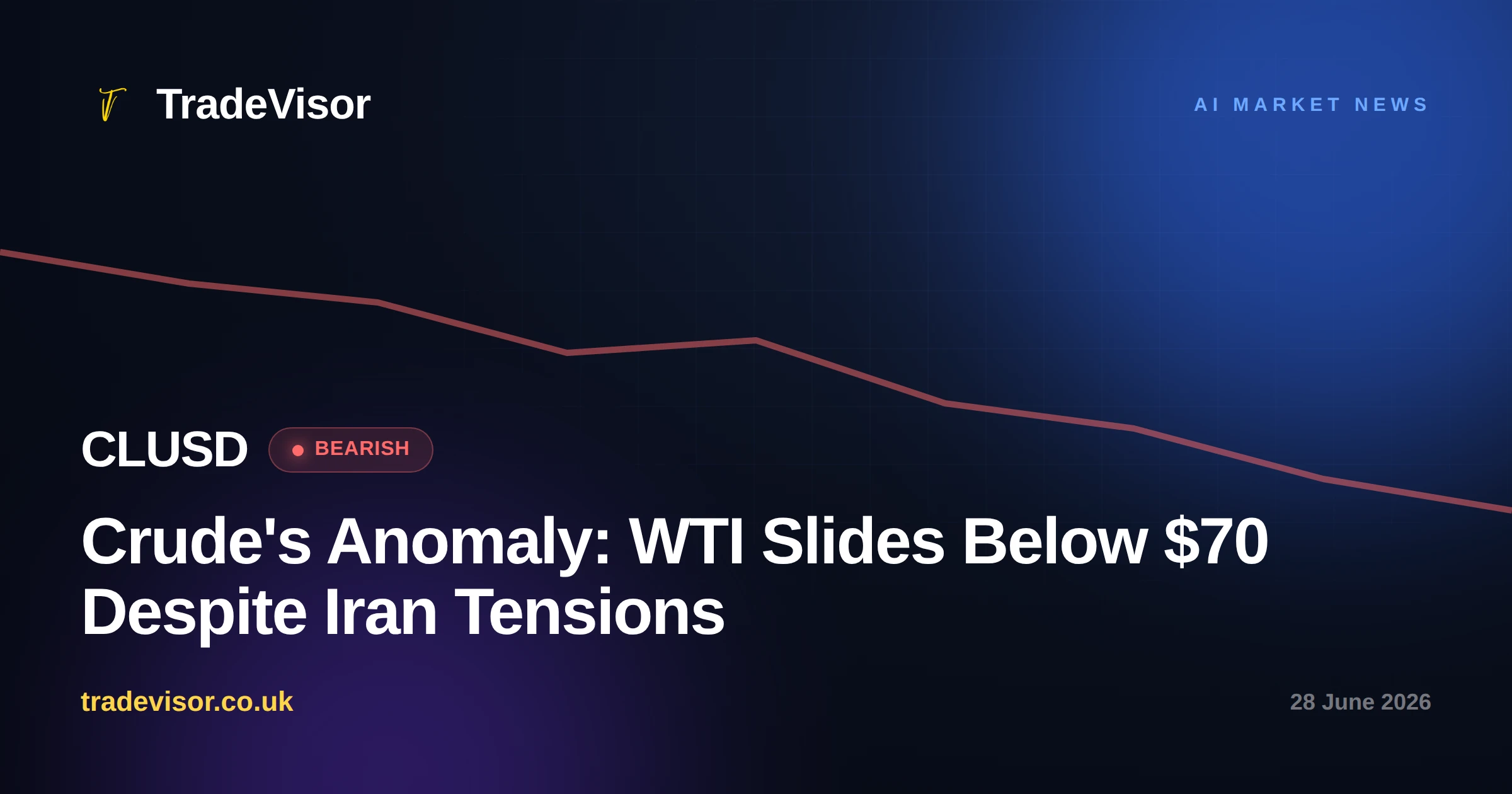
WTI crude just broke through a threshold that seems almost surreal. On Friday, U.S. oil futures dipped below $70 a barrel, extending a 26% rout over the past month. The trigger? An Iranian attack on a cargo ship in the Strait of Hormuz. Normally, news of an interdiction in the world's most critical oil chokepoint would send prices screaming higher. Instead, traders shrugged and sold.
An Assault the Market Refused to Buy
It has been a dizzying slide. Since the U.S.-Iran conflict erupted in February, crude spiked violently, then began a relentless retreat. According to Forbes, the initial war premium has fully evaporated, with prices now back to pre-war levels. The New York Post noted that traders remained optimistic about tanker traffic flow even after the latest attack paused a large-scale evacuation. More tankers reportedly navigated the strait successfully, per Forbes. FX Empire bluntly summed up the mood: "peace now seems likely." The market is pricing de-escalation, and it is doing so aggressively.
Yet the physical risks haven't vanished. Iran continues to restrict traffic, and the ceasefire is fragile. So why the sell-off? Part of the answer lies in what crude's slide is signaling about the broader economy.
Unpacking the Disconnect
CNBC highlighted a telling detail: trading in certain ETFs indicates that inflation fears are overblown. Bond bears had a rough week, and crude's weakness was a key reason. Falling oil dampens inflation expectations, which in turn can keep the Federal Reserve on hold. It is a circular narrative: a slowing economy pushes oil lower, and lower oil makes the Fed less likely to tighten, which supports risk assets, but not oil itself. That self-reinforcing loop has gained traction.
Meanwhile, equity investors are reassessing energy stocks. The Motley Fool observed that many oil companies had budgeted for $70 oil this year; now that WTI has fallen below, earnings estimates look shaky. The sector's underperformance is adding to the sense that the commodity has lost its geopolitical tailwind.
Demand Creeps Into the Frame
Supply disruption stories tend to dominate the news, but the demand side is quietly deteriorating. Global manufacturing is sputtering, China's recovery is uneven, and Europe is barely growing. If the world needs less oil, then even a genuine supply pinch in the Strait of Hormuz might not be enough to sustain a rally. The market seems to be sniffing that out.
TradeVisor's AI models are calibrated to weigh these competing forces. They monitor the spread between WTI and Brent, shipping insurance costs, and volatility indices to gauge whether price moves are overdone. Right now, momentum indicators lean heavily bearish, but the velocity of the decline is raising early warning signals for a potential snap-back if a tangible supply outage finally materializes.
What TradeVisor Flags Next
The path for CLUSD comes down to two catalysts. First, any concrete step toward a ceasefire or a confirmed reopening of the Strait beyond rumor would give the bears more ammunition. Second, the upcoming U.S. inventory report is critical. A sharp drawdown could shake the complacency; a build would confirm that physical markets are awash in crude, giving sellers free rein.
Trading crude here is a bet on whether the market's peace premium is justified. Prices have fallen to a zone where many producers bleed, and that has historically acted as a floor, provided demand holds. TradeVisor continuously scans the interplay between macroeconomic data, flows, and market structure to help traders distinguish noise from real turning points. That clarity is especially valuable when the headlines and the tape are telling such different stories.
Sources: CNBC, Forbes, Motley Fool, NY Post, FX Empire
Disclaimer: This article is AI-generated market analysis, also reviewed by our market experts, for informational and educational purposes only and does not constitute financial, investment, or trading advice. Figures are drawn from third-party news reporting and may not be exact. Trading forex and commodities carries a high level of risk. Past performance is not indicative of future results. Always do your own research.
Get this analysis on demand with TradeVisor
TradeVisor is an AI market-analysis app for forex & commodities — run on-demand AI Scans across 21 pairs with confidence scores and a full trade plan. Free to start, no broker connection, no auto-trading.