
What Is AI Trading? A Plain-English Guide
AI trading is the use of artificial intelligence to analyse financial markets — reading price charts, technical indicators, news and sentiment — and turn that analysis into a clear, evidence-backed view on where a market might go. In its most useful form, AI doesn't place trades for you. It does the heavy research a professional analyst would do, in seconds, and hands you a transparent breakdown so you decide.
That distinction — analysis vs. automation — is the whole story, and it's where most beginners get confused. This guide clears it up.
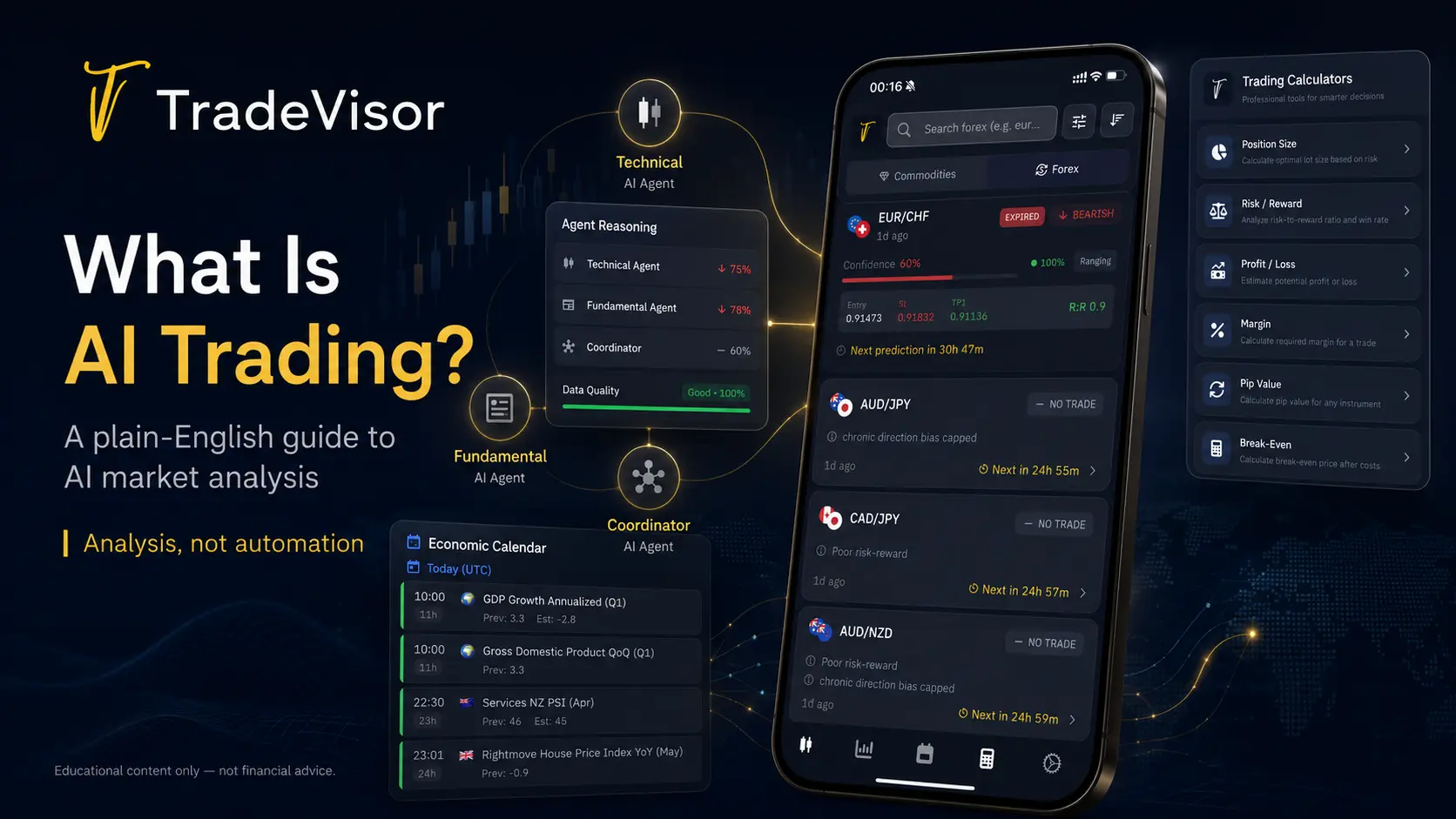
Educational content only. Nothing here is financial or investment advice. Trading carries a high level of risk.
AI trading in one sentence
AI trading means software using machine learning and large-scale data analysis to study a market and produce a directional read (bullish, bearish, or ranging) with the reasoning behind it.
Some products stop there and give you analysis. Others go further and execute trades automatically (these are "trading bots"). They are not the same thing, and the difference matters enormously for your risk, your control, and even whether the product is legal where you live.
| AI analysis | AI auto-trading bot | |
|---|---|---|
| What it does | Researches the market, shows you a view | Places real orders for you |
| Who decides | You | The bot |
| Touches your money | No | Yes — connects to a broker |
| Main risk | A view can be wrong | A view can be wrong and it trades on it automatically |
| Good for | Learning, second opinions, faster research | Hands-off automation (higher risk) |
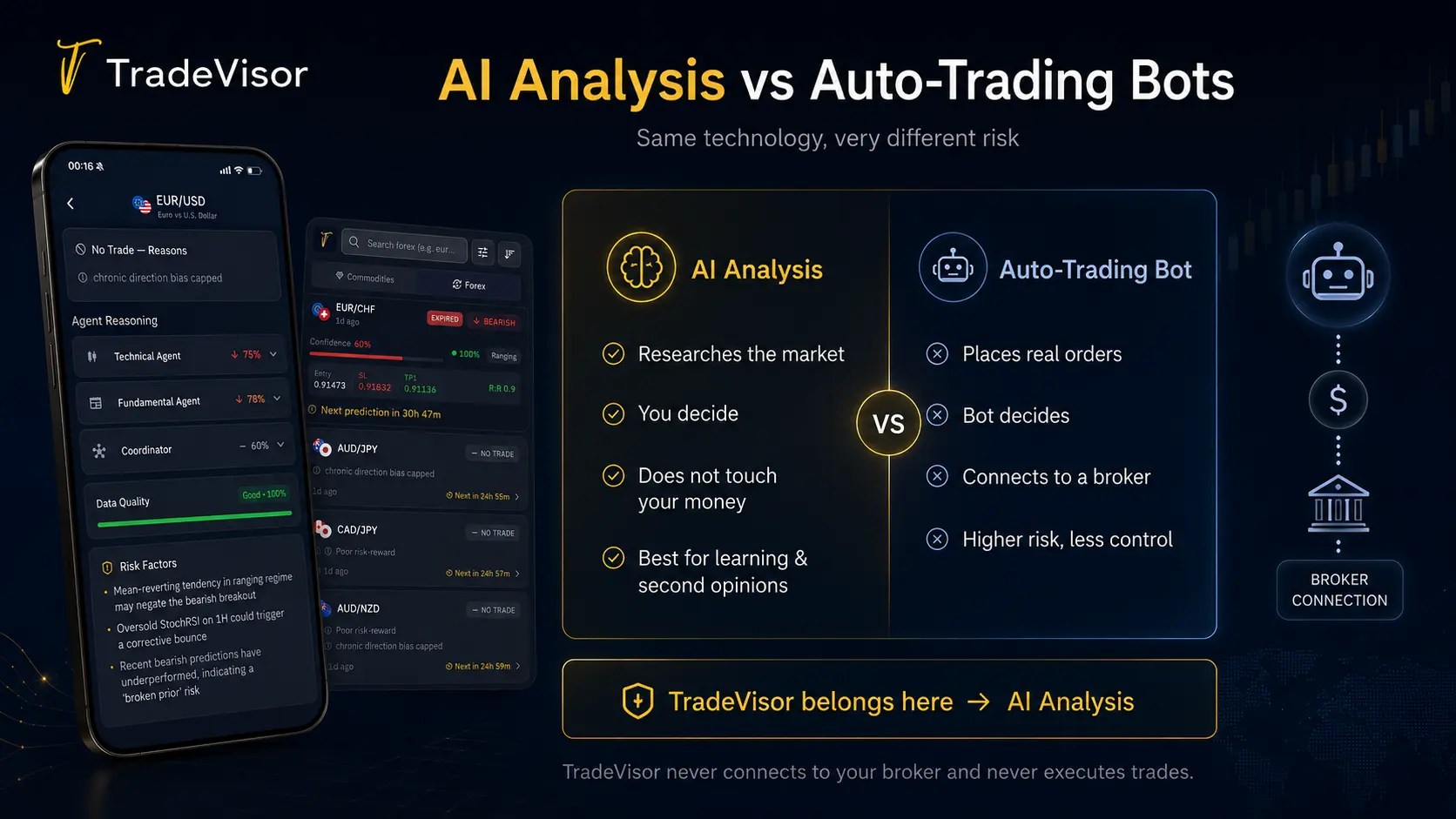
TradeVisor sits firmly in the analysis column: it never connects to your broker and never touches your money. You get the research; you keep the control.
How does AI trading work?
Under the hood, an AI analysis engine typically does four things:
- Pulls market data — live and historical prices across multiple timeframes (for example 15-minute, 1-hour, 4-hour, daily and weekly).
- Computes technical indicators — 20+ classic tools like RSI, MACD, moving averages, Ichimoku and Fibonacci levels, so it "sees" momentum, trend and support/resistance the way a chartist does.
- Reads fundamentals and news — economic releases, central-bank decisions and headline sentiment, so a strong technical setup isn't blindsided by an event the moment it's priced in.
- Synthesises a conclusion — it weighs everything into a single call: direction, a confidence score, and a risk plan (where the idea is invalidated, and realistic take-profit levels).
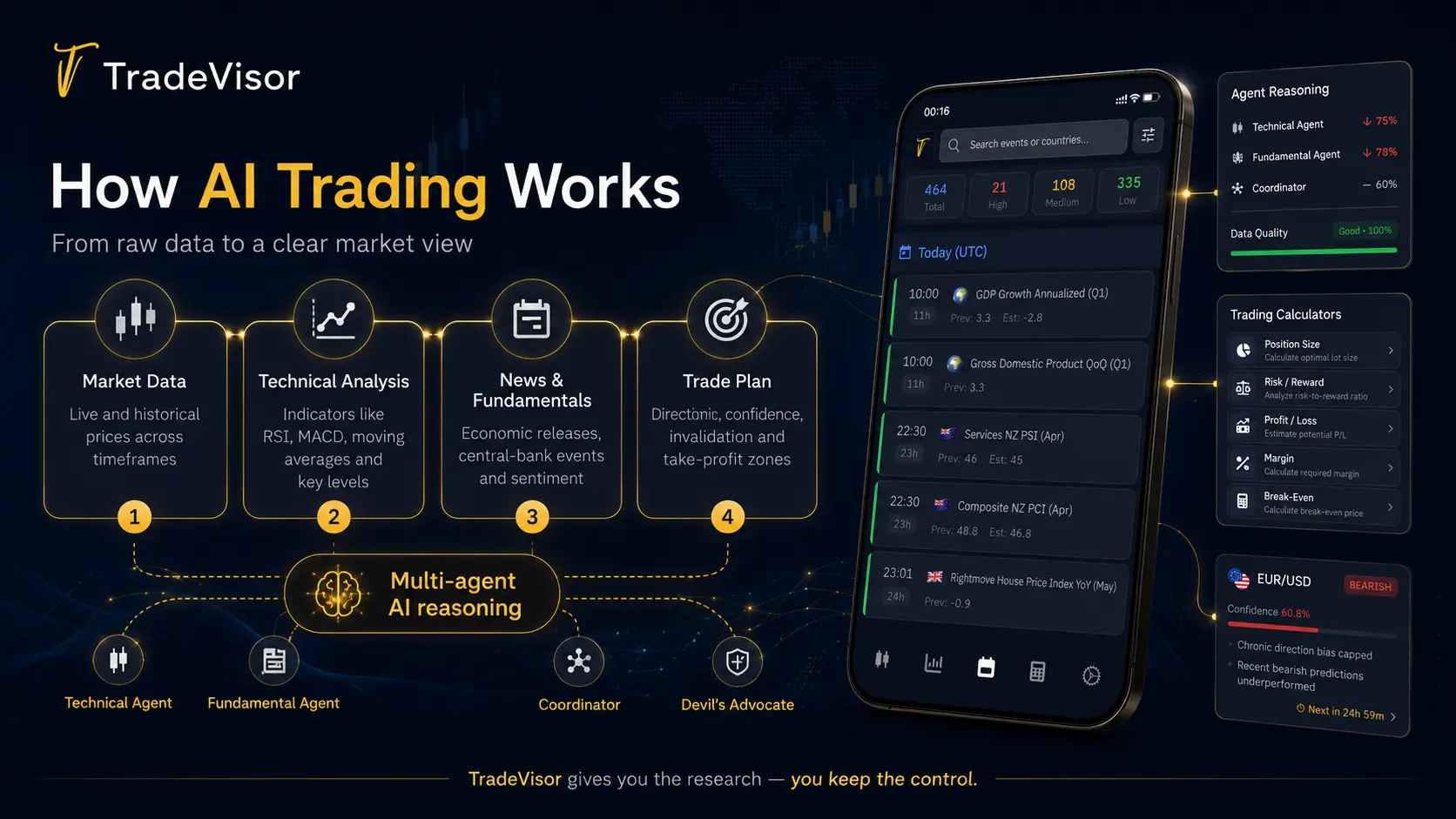
The better engines don't just give you a black-box answer. TradeVisor, for instance, runs multiple specialist agents — a Technical Agent, a Fundamental Agent, a Coordinator that reconciles them, and a Devil's Advocate that argues the other side — then shows each agent's reasoning so you can see why it reached a view, not just what the view is.
→ For the deep mechanism, see how TradeVisor's AI predictions work.
What does an AI analysis actually look like?
A single on-demand analysis (TradeVisor calls it a "Scan") returns something like this for, say, XAU/USD (gold):
- Direction: Bearish, 60% confidence, market regime "Ranging, low volatility"
- A full trade plan: Entry, Stop-Loss, a Partial take-profit, and TP1 / TP2 / TP3 levels, with a risk-to-reward ratio shown up front
- An invalidation level — the price that would prove the idea wrong
- Agent reasoning you can expand, each with its own confidence
- Signal health that updates as the market moves
Crucially, roughly half of candidate signals get filtered out by risk checks before you ever see them — the goal is fewer, higher-quality reads, not a firehose of noise.
Does AI trading work?
Honest answer: AI is very good at speed and consistency, and it is not a crystal ball. It can process more data than any human, never gets bored, and never trades on emotion. But no model predicts the future with certainty, markets are partly random, and any tool can be wrong on any given call.
So the realistic value of AI trading is:
- Faster research — minutes of analysis compressed into seconds.
- A consistent second opinion — it checks the things you might skip when you're tired or excited.
- Discipline — pre-defined entry, stop and targets discourage emotional decisions.
What it is not: a guaranteed-profit machine. Anyone promising that is selling you something. (We dig into the scams in Is AI trading legit and safe?.)
Is AI trading right for beginners?
It can be — if you start with analysis rather than automation, and if you start free. The lowest-risk way in is a tool that gives you AI analysis you can study, paired with paper trading or tiny position sizes while you learn. You see how the AI reasons, you compare it to what actually happens, and you build judgement.
→ New to this? Start with the free AI analysis app and learn by watching how the AI reasons.
Try AI market analysis free
TradeVisor gives you on-demand AI analysis across 21 forex and commodity pairs — free to start (ad-supported), ad-free if you upgrade, or simply buy a Scan when you need one. No broker connection. No auto-trading. No "guaranteed returns." Just the research, transparently shown, so you make the call.
Frequently asked questions
(These are real, high-volume questions from search — answered here to match People Also Ask and AI Overview.)
What is AI trading? AI trading is using artificial intelligence to analyse markets — charts, indicators, news and sentiment — and produce a directional view with the reasoning behind it. In its safest form it's analysis you act on yourself, not automated trading.
What is AI trading and how does it work? The AI pulls live and historical market data across timeframes, computes technical indicators, reads fundamentals and news, then synthesises a call (bullish/bearish/ranging) with a confidence score and a risk plan. Better engines show each step of the reasoning.
How do you trade with AI? You use the AI's analysis as input: review its direction, confidence and trade plan, sanity-check it against your own view and the news calendar, then decide whether and how to act — using your own broker and your own risk limits.
Does AI trading work? AI is excellent at fast, consistent, emotion-free analysis, but it cannot predict markets with certainty and can be wrong on any call. Treat it as a research assistant and second opinion, never a guarantee.
Is there a free AI trading app? Yes — TradeVisor has a free, ad-supported tier so you can run AI analysis without paying. You can go ad-free or buy individual Scans later. See the free app.
TradeVisor is an AI market-analysis app from CODOK LTD. It provides educational analysis only — not financial, investment or trading advice — and never connects to your broker or executes trades. Last updated: 2026.
Get this analysis on demand with TradeVisor
TradeVisor is an AI market-analysis app for forex & commodities — run on-demand AI Scans across 21 pairs with confidence scores and a full trade plan. Free to start, no broker connection, no auto-trading.